The short version
- We are a Luxembourg family, and the records prove it. The marriage of Johann Ludowise and Katharina Dries is recorded at Biwer on 31 January 1844, and the act names his parents, his birthplace and hers.
- The line runs seven generations, back through Syren to Sandweiler and a Peter Ludwig who was alive in the 1670s.
- The name began as Ludwig. The Sandweiler register writes it that way in 1720, and still writes it the German way — Ludigs — in 1759. Ludovicy, Ludovici and finally Ludowise came later, and nobody in the family chose any of them.
- The family left Luxembourg after May 1861. A daughter was born at Wecker that spring; her grandfather died in Wisconsin that autumn.
- The Cardinal story is almost certainly not ours — though there is a real papal son at the root of the Italian name, and his story is worth knowing.
What the name means
Ludowise belongs to a large European family of names built on the Latin Ludovicus, itself a Latinised form of the Old High German Hludwig — from hlūt, “famous,” and wīg, “war” or “warrior.” The same root produced Louis in France, Ludwig in Germany, Ludovico in Italy, Lewis in England and Clovis in the earliest Frankish records.
Across Europe, local languages built surnames from that root independently. Italian speakers formed Ludovisi and Ludovici. German speakers formed Ludwig. Luxembourgish speakers formed Ludovicy and Ludovissy. These are not branches of one family tree — they are separate inventions from the same raw material, rather like the way Smith, Schmidt and Ferrari all mean “blacksmith” without the families being related.
That distinction is the hinge of everything below. Our name is the Germanic and Luxembourgish one.
Ludovici or Ludovicy? Both — and neither is a different name
These two forms cause more confusion than anything else in the family record, and they turn up side by side often enough to look like a contradiction. They are not. One is Latin grammar; the other is French spelling.
Ludovicus is simply the Latin for Ludwig, and parish registers before 1796 were written in Latin. But a baptism entry rarely needs the name in its plain form — it needs “son of”, which in Latin means putting the father’s name in the genitive case. The genitive of Ludovicus is Ludovici. So when a priest wrote filius Petri Ludovici, he was not recording a surname spelt “Ludovici”; he was writing “son of Peter Ludwig” in correct Latin. The -i is a case ending.
Over generations that ending stopped being read as grammar and started being read as part of the name — which is how a great many European surnames were formed. Then, when French-language civil registration arrived in 1796, clerks wrote what they heard in a French orthography, and Ludovici became Ludovicy. French does not readily end names in -ici; -y was the natural spelling, and it is the same instinct that produced Ludovissy across the neighbouring communes.
So: Ludovici is the older, Latin, ecclesiastical form; Ludovicy is the later, French, civil form. They are the same name a century apart, and for a few decades either might appear depending on whether a priest or a registrar was writing. That is exactly what the 1844 act shows, with both forms on one page.
| Form | Language / cause | Attested | Where |
|---|---|---|---|
| Hludwig | Old High German root: “famous warrior” | — | ancestral to all below |
| Ludwig / Ludigs | German vernacular | 1720, 1759 | Sandweiler parish register |
| Ludovicus | Latin nominative | — | the form the two below are built from |
| Ludovici | Latin genitive — “son of” | 1845–1857 | Biwer birth register entries |
| Ludovicy | French civil respelling after 1796 | 1786, 1844 | Syren; body of the marriage act |
| Ludowissi | a brother’s branch in America | 1822–1879 | Wisconsin |
| Ludowise | American clerks, spelling by ear | 1884 | St. Anthony Cemetery, Minneapolis |
Read down that table and the whole history of the family is in it: a German village, a Latin church, a French administration, and an English-speaking country — each leaving its mark on six letters.
The Latin grammar is certain, and the forms in the right-hand column are all documented here. The causal account — genitive ending absorbed into the name, then respelt by French clerks — is the standard explanation for this whole class of European surnames and fits this family’s evidence exactly, but no document states it. It is the best reading of the pattern, not a quotation from a source.
The story about the Cardinal
The family rumour holds that we descend from an illegitimate child of an Italian Cardinal. If the story names anyone, it is almost certainly a Ludovisi.
The Ludovisi were a noble house of Bologna. In 1621 one of them, Alessandro Ludovisi, was elected pope as Gregory XV. He at once elevated his twenty-five-year-old nephew Ludovico Ludovisi (1595–1632) to cardinal — a textbook case of papal nepotism. The young cardinal became Archbishop of Bologna, Camerlengo of the Holy Roman Church and Vice-Chancellor, built the Villa Ludovisi in Rome, assembled one of the great collections of classical antiquities, and patronised Bernini and Guercino. His name still marks a district of central Rome.
He is exactly the sort of figure a family legend attaches itself to. What the records say about him is set out further down.
The records in Luxembourg
Luxembourg began civil registration in 1796, and the National Archives have digitised the resulting registers and released them to the public without charge. Among them are the tables décennales — ten-year indexes to every birth, marriage and death in each commune. Searching those indexes for our family returns the following.
| Event | Date | Commune | As indexed |
|---|---|---|---|
| Marriage of Johann’s parents | 28 Feb 1815 | Schuttrange | Ludovicy Nicolas × Beck Catherine |
| Marriage of Johann’s sister | 10 Jan 1842 | Schuttrange | Ludovicy Catherine × Delles Jean |
| Marriage of Johann & Katharina | 31 Jan 1844 | Biwer | Ludovicky Jean × Drus Catherine |
| Birth of Katharina Dries | 19 Jan 1824 | Biwer | Dries Catherine |
| Birth of son Nicholas | 30 Apr 1845 | Biwer | Ludovici Nicolas |
| Birth of son Michael | 18 Dec 1849 | Biwer | Ludovici Michel |
| Birth of daughter Marguerite | 11 Aug 1853 | Biwer | Ludovicy Marguerite |
| Birth of son Mathias | 30 Nov 1857 | Biwer | Ludovici Mathias |
Compare these against the dates on the American gravestones, recorded a century later and half a world away by people with no access to Luxembourg registers. Michael’s stone says 17 December 1849; the Biwer register says the eighteenth. Katharina’s memorial says 18 January 1824; the register says the nineteenth.
Those one-day gaps are not errors — they are the signature of authenticity. A civil birth act records the day the father appeared before the registrar to declare the birth, which was very often the following morning. Two independent bodies of evidence, generated a century apart on two continents, agree to within twenty-four hours.
The act itself
This is the document the whole question turned on: act No. 1 of the Biwer marriage register for 1844, written on a printed German form and signed by the family.
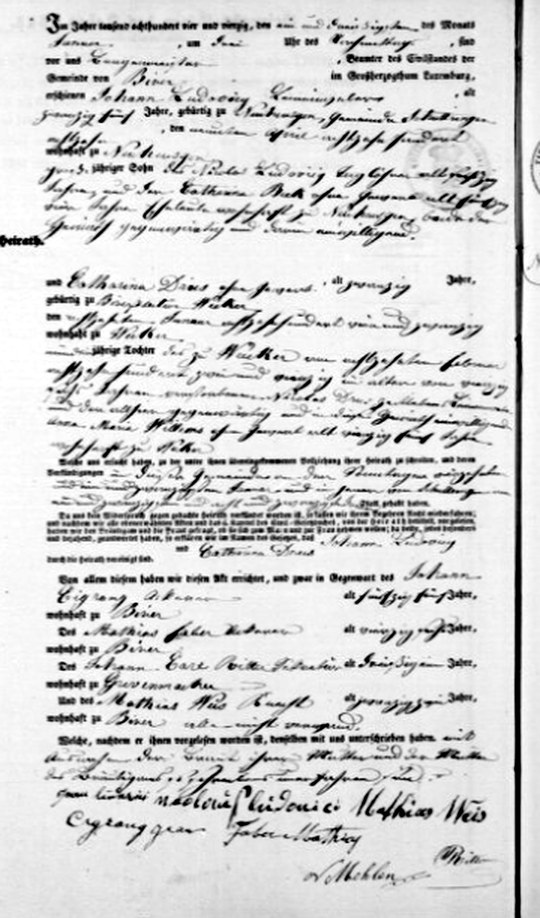
“In the year one thousand eight hundred and forty-four, on the thirty-first day of the month of January, before us, the mayor, registrar of civil status of the commune of Biwer, canton of Grevenmacher, in the Grand Duchy of Luxembourg, appeared Johann Ludovicy … born at Neuhäusgen, commune of Schuttrange, on the ninth of April … son of Nicolas Ludovicy and of Catharina Beck, married persons, resident at Neuhäusgen, both here present and consenting —
and Catharina Dries, without trade, born at Wecker on the …teenth of January eighteen hundred and twenty-four, daughter of the late Nicolas Dries, deceased at Wecker, and of Maria Willems, without trade, aged forty-five years, resident at Wecker, here present and consenting.”
The witnesses are named as Johann Eigrang, farmer, aged fifty-five, of Biwer; Mathias Faber, farmer, of Biwer; Johann Carl Ritter, tailor, of Grevenmacher; and Mathias Weis, of Biwer.
Two lines are worth pausing over.
The first is “born at Neuhäusgen, commune of Schuttrange, on the ninth of April.” That birthplace and date had been reported for years on the authority of an uncited memorial page transcribed in America a century later. Here it is in the register, written down in Luxembourg six weeks before the wedding, by a clerk who had the groom standing in front of him.
The second is “both here present and consenting.” Johann’s parents were in the room. Nicolas Ludovicy — born at Syren in 1786, who would be buried seventeen years later in Wisconsin — stood up at his son’s wedding in a village registrar’s office in January 1844 and gave his consent.
- A new generation
- The bride’s parents: Nicolas Dries, already dead by 1844, and Maria Willems, aged forty-five and living at Wecker. Neither name appears anywhere in the American records.
- A widow at the wedding
- Maria Willems gave consent as the surviving parent. Born about 1799, she was a widow raising a household at Wecker when her twenty-year-old daughter married.
- Trades
- Farmers, and a tailor from Grevenmacher. A working village wedding, not a notable one.
The scan is legible but not perfect. Johann’s occupation cannot be made out, nor can the exact day of Catharina’s birth — the word ends in “-zehnten,” consistent with either the eighteenth (as her gravestone has it) or the nineteenth (as the archives index has it). The signature at the foot is not legible either: magnified to the limit it supports Ludouici, Ludovici and Leidouici about equally. In German Kurrent the letter u carries a small curved mark that reads convincingly as an i-dot, and the same hand forms u and v almost identically. Only the body of the act is beyond doubt.
The line
m. Magdalena Deckers
m. 24 Apr 1743 Elisabeth Weber
children include Jacques (b. 1750) and Elisabetha (b. 22 Jan 1759)
m. 31 Dec 1782 Marie Thill
m. 28 Feb 1815 at Schuttrange
Catherine Beck b. 29 Sep 1790, Rameldange · d. 24 Mar 1847, Schuttrange
b. 9 Apr 1818, Neuhäusgen · d. 2 Mar 1884, Minneapolis
m. 31 Jan 1844 at Biwer
Katharina (Catherine) Dries b. Jan 1824, Wecker · d. 30 Nov 1893, Minneapolis
daughter of Nicolas Dries (d. by 1844) and Maria Willems
Buried together, St. Anthony Cemetery, Minneapolis — Section 28, Lot 1
Where the family actually came from
The most interesting correction is one of place. It is natural to assume Syren was the family’s home village, because that is where Nicolas was born in 1786. It was not. Jacques was born at Sandweiler in 1750 and only moved to Syren, some four miles south, on marrying Marie Thill at the end of 1782. He died there eleven years later.
Sandweiler is where the family had been for generations, and it shows in the surname statistics: the village is one of the densest concentrations of the name in Luxembourg.
The youngest daughter, Catherine, born at Wecker on 3 May 1861, is more useful than she looks. She means Johann and Katharina were still in Luxembourg that spring. Her grandfather Nicolas died at Dacada, Wisconsin on 6 October 1861, which means the older generation had already gone. The family crossed in waves, as most did — and Johann’s own departure falls after May 1861.
Dacada is a hamlet in the Luxembourger district of eastern Wisconsin, a few miles from the villages of Belgium and Luxemburg. Johann’s brother Nicolas died in Ozaukee County there in 1879. From that colony the family moved on to Minneapolis, and later branches to Chippewa County, Wisconsin, to Michigan, and eventually to the Pacific coast. One daughter went furthest of all: Margaret died at Norman, Oklahoma in 1913 and is buried at Wanette, remembered in her obituary as a pioneer of Pottawatomie County.
The generations above Nicolas came originally from Luxembourg family trees rather than registers. The 1720 baptism has since been found and read — see below — and it confirms Bernard’s date, his mother’s name and the village exactly. The link from Bernard up to Peter is therefore documented. The generations either side of it still rest on the trees.
One internal detail argues for their soundness. Luxembourgish families named children for their grandparents, and the pattern holds here without anyone having arranged it: Jacques, son of Bernard, named a son Bernard in 1787.
The oldest page
The Sandweiler baptism register was opened at February 1720, and the entry is there — four lines of Latin, written by a village priest three hundred and six years ago.
“15 feb 1720 Bernardus filius legitimus Petri Ludwig junioris et Magdalena Deckers Conjugum in Santweiler. Susceptores Bernardus Thielen de Santweiler et Elisabetha Deckers avia.”
— 15 February 1720. Bernardus, legitimate son of Peter Ludwig the younger and Magdalena Deckers, married couple at Sandweiler. Sponsors: Bernardus Thielen of Sandweiler, and Elisabetha Deckers, grandmother.
The page itself can be read at the archive: Sandweiler KB-01, image 21 — the entry is the second one down on the left-hand page. The scans are held by the Archives diocésaines de Luxembourg and are not reproduced here.
Every detail the family trees claimed is confirmed: the date to the day, the child’s name, the mother’s name, the village. But the entry gives two things nobody was looking for.
The name was Ludwig
The father is not written Ludovicy. He is written Ludwig — the plain German form — and a later hand has underlined it, evidently having noticed the same thing.
This is the missing link. Here is the family moving through the forms inside its own records: Ludwig at Sandweiler in 1720, Ludigs still at Sandweiler in 1759, Ludovicy at Syren by 1786, Ludovicy and Ludovici on one page in 1844, and Ludowise on a Minneapolis headstone in 1884.
It also settles the question this whole enquiry began with, about as firmly as it can be settled. A family recorded as Ludwig in a German-speaking Luxembourg village in 1720 is not a branch of a Roman princely house.
So did the family change its own name?
Almost certainly not — and a second page from the same register shows why. On 22 January 1759 the same Bernard, by then thirty-eight and fifteen years married, had a daughter Elisabetha baptised at Sandweiler. Thirty-nine years after his own baptism, the name is still written the German way — and written twice, once for each parent.
“hac 22da januarii 1759 nata et Baptizata est Elisabetha Ludigs Bernardi et Elisabetha Ludigs conjugum de Santweiler filia legitima. Patrini astiterunt Dominicus Meisenburg et Elisabetha Wagener ambo de Santweiler.”
— On this 22nd of January 1759 was born and baptised Elisabetha Ludigs, legitimate daughter of Bernard and Elisabetha Ludigs, a married couple of Sandweiler. Sponsors: Dominicus Meisenburg and Elisabetha Wagener, both of Sandweiler.
It sits at the foot of the right-hand page of Sandweiler KB-01, image 60, and both occurrences of Ludigs carry the same later hand’s underline that marks Ludwig in 1720. The mother appears simply as Elisabetha under the married form of the name — consistent with the Elisabeth Weber whom Bernard married in 1743.
So the change did not happen gradually across the eighteenth century, and it did not happen at Sandweiler at all. It happened between 1759 and 1786 — and sitting squarely in that gap is 1782, the year Jacques married and moved four miles south to Syren, into a different parish, under a different priest.
What turned a translation into a surname was administration. When French civil registration arrived in 1796, the form that happened to be on the paper at that moment became the family’s legal name — and by then the family was at Syren, where the Latin form was in use. Nobody decided this. The same process, running independently in neighbouring villages, is what produced Ludovissy, Ludowissi, Ludowese, and eventually Ludowise. Even in 1844, with the family standing in the room, the registrar and the signer could not agree on how to spell it.
“The younger”
The priest did not write Peter Ludwig. He wrote Petri Ludwig junioris — Peter Ludwig the younger — because there was an older Peter Ludwig in that village whom a reader might otherwise have confused him with.
The family trees claim, without any supporting document, that Peter’s own father was also called Peter. That single Latin word, written for an entirely practical reason by a priest with no interest in posterity, independently corroborates it. It does not name the man. But it says he was there.
Modern genealogy databases list these Sandweiler people under Ludovicy. That is the indexers normalising a variable name to one heading, not what the register says. The pages say Ludwig and Ludigs. Worth remembering whenever an index looks more certain than it is.
What the Italian archive says
The Boncompagni Ludovisi family archive has been digitised in part and published online with scholarly commentary. It was searched directly, along with the standard reference works on the cardinals. The result is a clear negative.
- Cardinal Ludovico Ludovisi — no children, legitimate or otherwise, in the Dizionario Biografico degli Italiani, in Miranda’s Biographical Dictionary of the Cardinals, or in the Catholic Encyclopedia. Three independent authorities, all silent.
- Pope Gregory XV, and the later cardinals Niccolò Albergati-Ludovisi and Ignazio Boncompagni Ludovisi — none recorded.
- The extinction of the male line in 1700 — the rival claims came from distant Appiani cousins. No illegitimate claimant appears anywhere in the dispute.
- Emigration — the archive states that the first member of the family to settle permanently in the United States arrived in 1938. He was legitimate, and his only child died before him.
The one genuine “natural son” anywhere in the Ludovisi record is Astorre, son of a Nicolò Ludovisi of Bologna — killed in factional street fighting in 1403, without issue, nearly two centuries before the Cardinal was born.
So where did the story come from?
Here the search turned up something unexpected. The rumour is true of that family — just not of the Ludovisi, and not in a way that could reach us.
The princely house carrying the Ludovisi name today is Boncompagni Ludovisi, and its entire male line descends from Giacomo Boncompagni (1548–1612), the illegitimate son of Pope Gregory XIII by a domestic servant. The archive preserves the pope’s own blunt account of the affair, and the three separate legal acts — 1548, 1552, and a papal bull in 1572 — by which the boy was legitimated.
So a real papal son does sit at the root of the modern Ludovisi name. But he was legitimated into the dynasty rather than cast out of it; his descendants are the princes of Piombino; and they are traceable in an unbroken, exhaustively documented line to the present day. That is not a line anyone loses track of, and it does not end in a Minnesota cemetery.
What seems far likelier is that someone in the family, at some point, noticed that our name resembled a famous papal house — a resemblance entirely real at the level of language, since both descend from Ludovicus — and the story grew from there. Family legends are usually built out of something true, just not the thing they claim.
An illegitimate child leaves no pedigree by definition, so the silence of the archives is weaker evidence than it looks; and the digitised archive indexes the scholarly commentary rather than the full text of every document. The fair verdict is not proven and improbable — not disproven.
But it is worth saying plainly what has replaced it. We have exchanged an unverifiable claim on a Roman palace for a documented family of Luxembourgish villagers, traceable by name and village and date across seven generations and an ocean. That is the better inheritance.
How much further back can this go?
Further than one might expect, and the answer is unusually precise, because it depends entirely on which books happen to have survived in which parish. All of them are digitised and free to read on Matricula, with no login.
| Parish | Book | Covers | Events it should contain |
|---|---|---|---|
| Contern | KB-07 | 1779–1793 | Nicolas’s baptism 1786; Jacques & Marie Thill’s marriage 1782; Jacques’s death 1793 |
| Sandweiler | KB-01 | 1705–1778 | Bernard’s baptism 1720 (found); Elisabetha’s baptism 1759 (found); his marriage 1743; Jacques’s baptism 1750; Peter’s death 1763 |
| Sandweiler | KB-32 | 1779–1793 | Bernard’s death 1790 |
| Contern | KB-01 | 1621–1752 | The Thill family of Syren |
| Biwer | KB-09 | 1731–1783 | Baptisms only — the Dries family of Wecker |
| Biwer | KB-06 | 1779–1793 | The only pre-1796 Biwer marriages and deaths that survive |
- The Ludwig line — solid to about 1705
- Sandweiler KB-01 opens in 1705 and runs unbroken to 1778, carrying baptisms, marriages and deaths in one volume. Four of the six upper-generation events sit inside it.
- Then a hard wall
- Peter the younger was born about 1700, five years before the register begins, and his parents married before that. Sandweiler has nothing earlier. The marriage register does not start until 1726, so his own marriage, about 1719, is gone too.
- The Dries line — shallow
- Biwer holds baptisms from 1731 and nothing else before 1779. The 1730s is realistically the end of that side.
The one remaining thread
Sandweiler’s death register for 1710–1740 survives as a loose insert in the same volume. If Peter Ludwig the elder died in those thirty years — and a man born in the 1670s well might — his burial entry is in it, and it would give the name of the oldest member of this family it will ever be possible to know.
Two other things would help. The 1766 Cadastre of Maria-Theresa, a household-by-household survey of the whole Duchy, is now online free at the Archives nationales; it would show what the family actually held at Sandweiler three years after Peter died, and test that intriguing claim that he was the village mayor. And the University of St. Thomas in St. Paul holds a dedicated Luxembourg parish and civil records collection covering 1600–1890 — the Luxembourger migration to Minnesota was heavy enough that the archive followed the people.
A note on method
This account was built in stages, and several early conclusions turned out to be wrong. They are listed here rather than quietly removed, because knowing which claims failed is the only way to judge the ones that held.
- The surname Dries is not Luxembourgish. It was offered early as supporting evidence. It is overwhelmingly Dutch and Flemish — some 39,000 records in the Netherlands against roughly sixteen in Luxembourg. Katharina’s birth at Wecker is confirmed in the Biwer register regardless, so the conclusion survived; the reasoning did not.
- St. Anthony Cemetery was not a Luxembourger burial ground. It opened in 1857 as the cemetery of the first Catholic parish in Minneapolis, serving a mixed French-Canadian, German and Irish congregation. Burial there carries no ethnic signal either way.
- Syren was not the family’s home village. Sandweiler was.
- The signature on the 1844 act was at one point reported as reading Ludovici. It is not legible at the available resolution and that claim was withdrawn.
- The Ludigs baptism was first cited here as 22 January 1758. The correct date is 22 January 1759. The facing page of the very same opening carries a 22 January 1758 baptism for an unrelated family — Maria Thillen — and the two were transposed. The entry itself is genuine, and is now quoted and cited in full above.
The first two errors both ran toward the conclusion the evidence already favoured. That is the easiest mistake to make in family history and the most important to catch.
Sources
- Archives nationales de Luxembourg, Tables décennales and civil registers for Biwer, Schuttrange and Weiler-la-Tour, digitised and released as public domain.
- Biwer marriages 1797–1858, register CT-03-02-0096.
- Archives diocésaines de Luxembourg, Sandweiler parish register KB-01 (1705–1778), images 21 and 60, via Matricula Online.
- Matricula Online, Contern and Biwer parish books.
- Find a Grave memorials for Johann Ludowise, Katharina Dries Ludowise, Michael Ludowise and Margaret Brandenburg.
- Geneanet, surname distribution and archival register indexes for LUDOVICY, LUDOVISSY, LUDOWESE and DRIES.
- Archivio Digitale Boncompagni Ludovisi, ed. T. Corey Brennan — villaludovisi.org.
- Dizionario Biografico degli Italiani (Treccani), entries for Ludovico Ludovisi, Niccolò Ludovisi prince of Piombino, and Nicolò Ludovisi (d. 1406).
- Salvador Miranda, The Cardinals of the Holy Roman Church, consistory of 15 February 1621.
- Catholic Encyclopedia, “Pope Gregory XV”; European Heraldry, House of Boncompagni.
- Berdina Ludovissy Putzier, The Ludovissy Family from Clemency, Capellen, Luxembourg to Clayton County, Iowa, 2nd ed. (Tennessee Valley Publishing, 2000).
- Library of Congress, “Luxembourgers in America” research guide.